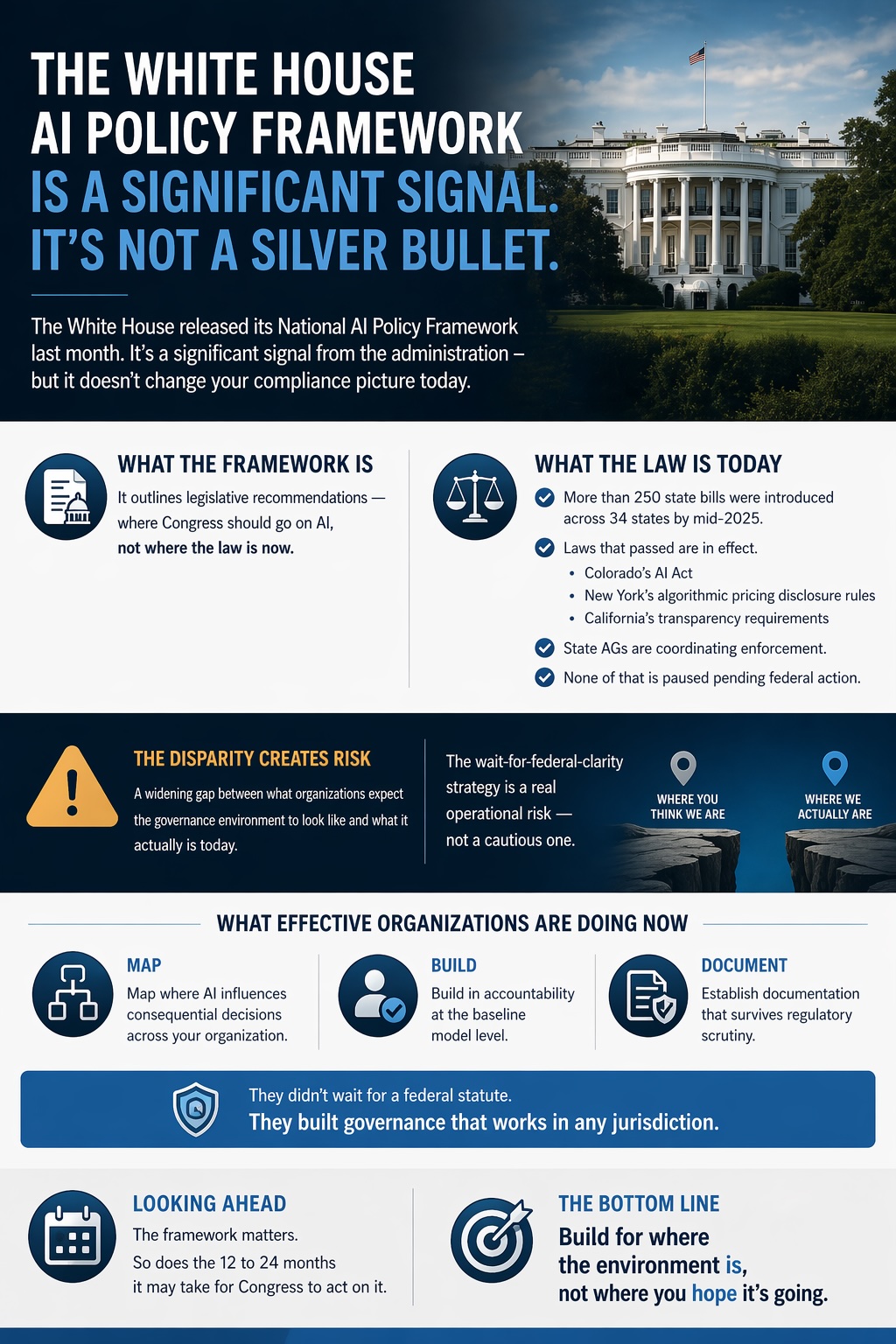
In March, the White House released its National Policy Framework for Artificial Intelligence — a 30-page document signaling where the administration wants Congress to go on AI legislation. It is a meaningful step. It is not, however, the answer most enterprise leaders are waiting for.
The framework offers legislative recommendations, not binding requirements. It proposes a unified national standard designed to preempt the growing patchwork of state AI laws. It calls for AI regulatory sandboxes, streamlined federal permitting for AI infrastructure, and a governance approach that relies on existing agencies — the FDA, CMS, FTC — rather than a new standalone regulator.
What it doesn’t do is change anything on the ground today.
The Operational Reality
What we see across enterprise, healthcare, and defense organizations is a consistent pattern: leadership teams are monitoring federal developments while continuing to deploy AI at pace. The assumption — sometimes stated, often implicit — is that clarity is coming, and when it arrives, governance will follow.
That assumption carries real risk.
More than 250 state AI bills were introduced across 34 states by mid-2025. Colorado’s AI Act requires risk assessments and documentation for high-impact AI systems. New York’s Algorithmic Pricing Disclosure Act mandates transparency when AI drives individualized pricing decisions. California has layered in disclosure requirements around AI-generated content and generative AI training data. These laws are not paused pending federal action. They are in effect. State attorneys general are coordinating enforcement. The risk is not theoretical — it is active.
The White House framework explicitly acknowledges that federal preemption — if it comes — will preserve state authority over consumer protection, fraud, and child safety. The patchwork won’t disappear entirely even if Congress acts.
What’s Changing
The enforcement posture has shifted. What was once primarily a regulatory compliance question is now an operational liability question. We’re seeing AI-related enforcement actions expand beyond privacy into pricing conduct, hiring decisions, insurance underwriting, and content moderation. Class actions are following enforcement trends. Boards are asking questions that operating teams aren’t yet prepared to answer.
The White House framework’s call for preemption is a policy ambition. Congressional timelines are their own reality. The practical implication is that organizations operating under the current state patchwork may be doing so for another 12 to 24 months, minimum — and that timeline assumes meaningful legislative progress, which is not guaranteed.
Practical Implications for Decision-Makers
The organizations managing this well aren’t waiting. They’re building governance infrastructure that works across jurisdictions — not because a specific state requires it yet, but because the trajectory is clear.
Three practices consistently distinguish organizations that are ahead of the curve:
First, they have mapped where AI is making or influencing consequential decisions — employment, pricing, patient care, underwriting — and applied risk assessment frameworks to those specific use cases, not to AI broadly. Blanket AI policies don’t satisfy regulators; use-case-level documentation does.
Second, they have established accountability at the model level, not just the policy level. They know who owns documentation, who signs off on risk assessments, and who is responsible for explaining how a specific AI output was generated. When a regulator asks, the answer exists — and it’s accurate.
Third, they have built transparency practices that work externally as well as internally. Governance that only satisfies internal audit is governance that hasn’t been stress-tested. The organizations ahead of this build for external scrutiny from the start.
Where This Goes
The federal framework is a signal, not a solution. It tells us which direction the administration wants to move. It tells us what Congress may eventually debate. What it doesn’t tell us is when — or what the final version will look like after a legislative process that has, to date, produced no comprehensive AI statute.
What we know now: enforcement is active. State laws are operative. The gap between AI deployment velocity and governance readiness is widening, not closing. Organizations that treat the White House framework as a reason to wait are trading operational risk for perceived regulatory simplicity.
The better posture is to build governance that’s durable regardless of where federal legislation lands. That work is available to do today. Organizations that start now will have a structural advantage over those waiting for federal clarity that may — or may not — arrive on schedule.
The best vantage point is earned. Not waited for.
This governance gap is not unique to federal contractors: Agentic AI Governance: A Framework for Enterprise Deployment and EU AI Act Compliance for US Companies examine the same structural problem in enterprise and cross-border contexts.
About the Author
Lynn Welch is the Founder and Principal of The Lion’s View, an independent AI and extended reality advisory firm serving PE investors, enterprise organizations, and defense agencies. Vendor-neutral, no platform to sell.
Sources & Further Reading
White House National Policy Framework for Artificial Intelligence (March 2026)
Holland & Knight: White House Releases National Policy Framework for AI
Morgan Lewis: AI Enforcement Accelerates as Federal Policy Stalls and States Step In
Cooley: White House AI Regulatory Blueprint — What It Means for Companies
Consumer Finance Monitor: What the White House Framework Means and What Comes Next
Credo AI: Latest AI Regulations — What Enterprises Need to Know in 2026
Nixon Peabody: White House Releases National AI Legislative Framework
Comments are closed