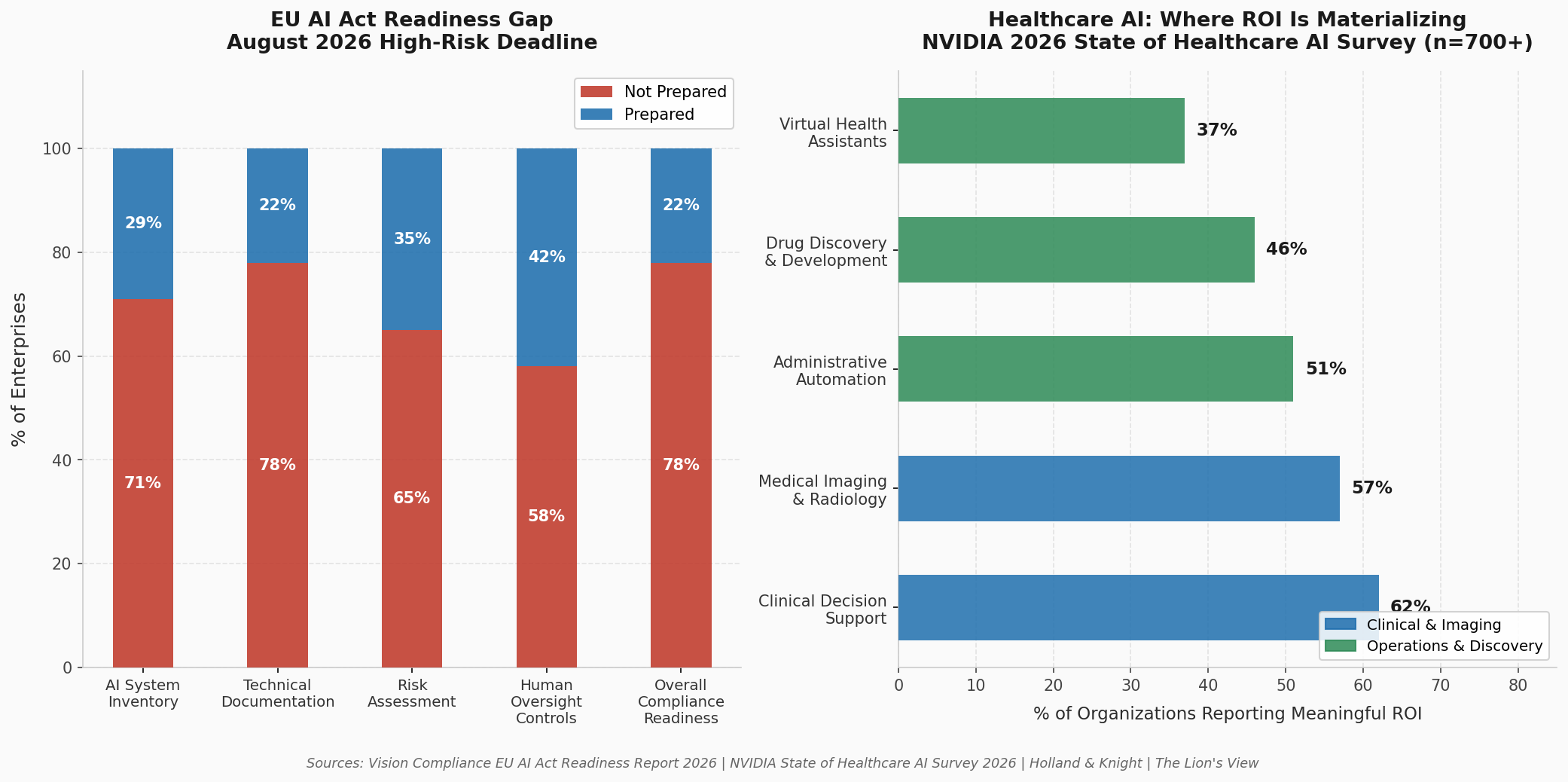
Three months out from the high-risk compliance deadline, 78% of enterprises have not taken meaningful steps. That gap is an operational liability — and it extends well beyond Brussels.
What we’re seeing right now is a familiar pattern. The regulatory timeline was published. The requirements were documented. And the majority of organizations did exactly what they do with every compliance deadline: they waited.
August 2026 is no longer theoretical. The EU AI Act’s high-risk obligations become fully enforceable in roughly three months. A new readiness report from Vision Compliance found 78% of enterprises have not taken meaningful steps toward compliance. More than half lack systematic inventories of the AI systems they are currently running in production. That is the operational reality.
78% of enterprises have not taken meaningful steps toward EU AI Act compliance — three months before enforcement begins.
For U.S. organizations, the instinct is to treat this as a European problem. It is not. Any company that operates in EU markets, serves EU-based customers, or sells AI-enabled products and services into EU jurisdictions falls under the Act’s scope. And the penalties are not symbolic. Non-compliance can cost up to 7% of global annual revenue. General counsel and CFOs are beginning to understand that this is a material risk exposure, not a compliance department initiative.
What the Regulation Actually Requires
The Act creates a tiered risk framework. High-risk systems — those used in healthcare, education, employment, critical infrastructure, and law enforcement — carry the heaviest obligations. These are not future scenarios. They are current deployments in hospitals, manufacturing facilities, financial institutions, and defense-adjacent commercial environments.
The compliance requirements are operational, not theoretical. Organizations must:
- Maintain a complete inventory of every AI system in production or development
- Produce Annex IV technical documentation for each high-risk system
- Conduct and document formal risk assessments
- Implement ongoing human oversight controls with audit trails
- Perform third-party due diligence on AI vendors and models used in high-risk contexts
Organizations that have been operating under agile development models with minimal documentation are in the most difficult position. Retrofitting governance artifacts onto systems that have been in production for 18 months is considerably harder than building that documentation from the start. The companies that understood this six months ago are in a fundamentally different conversation than those starting now.
The Holland & Knight analysis of April 2026 makes clear there is a slim chance the European Commission’s Digital Omnibus package could push high-risk obligations for some Annex III systems to December 2027. Organizations should not plan around that possibility. Prudent compliance posture treats August 2026 as binding.
The Healthcare Sector: Governance and ROI Are Not Separate Conversations
Nowhere is the governance gap more consequential than healthcare. The EU AI Act places clinical decision support tools, medical imaging analysis systems, and patient triage platforms squarely in the high-risk category. These are also, according to NVIDIA’s 2026 State of Healthcare AI Survey, the exact systems where organizations are reporting the clearest return on investment.
NVIDIA surveyed more than 700 healthcare and life sciences organizations. Seventy percent now actively deploy AI. That is up from 63% in 2024. Among those deploying, 85% report AI is increasing revenue, and 80% report cost reductions. The ROI case has moved from aspirational to documented.
Clinical decision support and medical imaging are the top two use cases with measurable returns — 62% and 57% respectively reporting meaningful impact. Drug discovery is third, cited by 46% of pharmaceutical and biotechnology respondents. These numbers matter because they signal that healthcare AI is no longer in a pilot phase. It is operational.
Seventy percent of healthcare organizations now actively deploy AI. That is not the pilot stage. That is operational infrastructure — and it requires governance infrastructure to match.
The counterintuitive point: the organizations most advanced in AI deployment face the highest compliance risk under the EU AI Act precisely because their systems are consequential. A clinical AI tool that is genuinely influencing physician decisions is, by definition, high-risk under the Act’s taxonomy. The faster adoption moves, the more governance has to move with it.
The full NVIDIA survey findings are available at blogs.nvidia.com.
Manufacturing: From Pilot to Production — Where Scale Breaks
Manufacturing is in a similar inflection. Deloitte projects a fourfold increase in agentic AI adoption in the sector this year — from 6% to 24%. Microsoft’s March 2026 manufacturing industry analysis describes companies at the “agentic era” inflection point, where AI transitions from assistive to autonomous: systems that reason, plan, and execute without a human in each decision loop.
The ROI numbers for manufacturing AI are compelling. Plants deploying agentic systems report productivity gains of 20–30%, machine downtime reductions of up to 50%, and energy cost savings of 25%. Predictive maintenance AI typically validates ROI within 90 days.
Here is the problem: between 68% and 95% of manufacturing AI pilots fail to scale. That statistic comes from multiple industry sources and reflects a consistent root cause. Organizations invest in a proof of concept, demonstrate value in a controlled environment, and then discover that their data infrastructure, integration architecture, and governance frameworks cannot support enterprise deployment. The gap is not technical capability. It is operational readiness.
The EU AI Act adds a layer to this. Autonomous manufacturing systems that make consequential decisions — quality control, production scheduling, safety interventions — may well fall into the high-risk category depending on their application. Manufacturers entering the agentic era without governance frameworks are building a liability on top of a productivity gain.
Defense and Federal: A Different Clock
The defense sector operates under a different regulatory clock, but the underlying governance challenge is structurally identical. The 2026 DoD AI Strategy shifts priority to speed of deployment. Each Service Chief and Combatant Commander has been directed to designate an AI Integration Lead. The NDAA requires a framework for AI model risk mitigation, including threats specific to AI systems: model tampering, adversarial prompt injection, data provenance compromise.
The DoD’s April 2026 guidance on agentic AI services is worth reading carefully. It emphasizes layered defense and strict access controls across the development and deployment pipeline. This is not abstract cybersecurity guidance. It reflects an operational reality: agentic AI in defense contexts can execute consequential actions at machine speed, with limited human review at each step.
What defense-adjacent commercial firms often underestimate: the governance posture required for federal contracting is converging with EU AI Act requirements. Organizations that build compliant, documented AI governance for one regulatory environment create a transferable strategic asset for the other. That convergence is not widely recognized yet.
The DoD April 2026 agentic AI guidance is publicly available at media.defense.gov.
What Decision-Makers Should Do Now
The organizations that will close the compliance gap in time are not the ones with the most sophisticated AI. They are the ones that treat governance as an operational function rather than a documentation project.
Three practical starting points:
- Build the inventory. You cannot govern what you cannot see. An accurate, current catalog of AI systems in production — including vendor-provided tools, embedded models, and third-party APIs — is the minimum viable starting point for any compliance conversation.
- Risk-classify before you document. Not every AI system carries high-risk obligations. Prioritize documentation and oversight controls for systems that touch consequential decisions: clinical pathways, production safety, credit and insurance, employment screening. That is where regulatory and reputational exposure is concentrated.
- Do not assume the extension. The proposed Digital Omnibus delay to December 2027 for some Annex III systems is not confirmed. Boards and executive teams that are managing August 2026 as a hard deadline are making the right call.
The August deadline is three months out. That is enough time to make meaningful progress — if organizations start with clarity about where their actual exposure sits, and build governance frameworks that serve compliance requirements without slowing the AI adoption that is already delivering measurable returns.
Governance is not the brake on AI adoption. It is what makes adoption sustainable at scale.
Where that exposure sits looks different by sector. A scoped AI & XR Due Diligence Checklist review is usually the practical starting point, followed by sector advisory: Commercialization Advisory for healthcare and manufacturing organizations, or Government & Public Sector Advisory for defense and federal entities.
Reference Sources
- Vision Compliance: EU AI Act Readiness Report 2026 (via National Law Review)
- Holland & Knight: U.S. Companies Face EU AI Act’s August 2026 Compliance Deadline
- NVIDIA: State of AI in Healthcare and Life Sciences Survey 2026
- Dataiku: Manufacturing’s 2026 Mandate: From AI Pilot to Agentic Profit
- Microsoft: Manufacturing at the 2026 Inflection Point: How Frontier Companies Are Entering the Agentic Era
- DoD: Careful Adoption of Agentic AI Services (April 2026)
- Deloitte: The State of AI in the Enterprise — 2026 AI Report
Organizations weighing similar deadlines domestically can review The Federal AI Policy Framework and Agentic AI Governance: A Framework for Enterprise Deployment.
About The Lion’s View
The Lion’s View is an independent AI and extended reality (XR) advisory firm serving PE/investment firms, enterprise and healthcare organizations, and defense and government agencies. Vendor-neutral. No platform to sell. Focused on helping decision-makers make the right call before capital, reputation, and operational complexity are at risk. Learn more at thelionsview.com.
Comments are closed