Every AI-enabled target we review this year clears the demo. That was never the hard part. The demo was built by people who know exactly which questions get asked in a first meeting, and they optimized for those questions months before the data room opened. The harder question — the one that actually determines whether the acquisition holds its value through integration — is what happens to that AI capability once it is disconnected from the founding team’s tribal knowledge and handed to an operating partner’s team eighteen months from now.
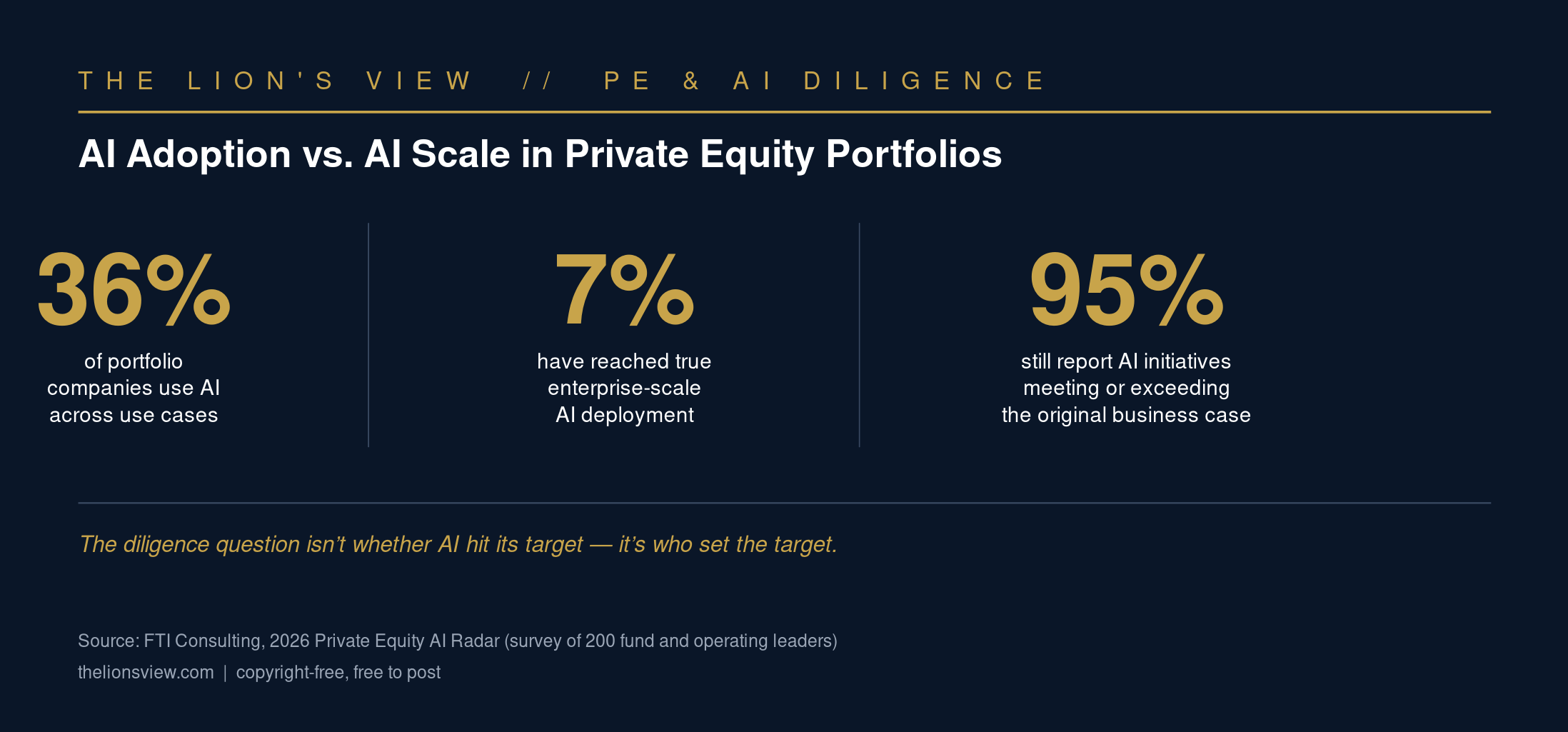
That is the operational reality private equity firms are running into in 2026. According to FTI Consulting’s 2026 Private Equity AI Radar, a survey of 200 fund and operating leaders, only 36% of portfolio companies are using AI across meaningful use cases, and just 7% have reached true enterprise scale. The rest sit somewhere between a pilot and a press release. A due diligence process built around a demo and a pitch deck will not tell you which bucket your target actually falls into.
Why the Standard Technology Checklist Misses AI Risk
Traditional technology diligence was built for static software: licensing terms, infrastructure costs, code quality, security posture. AI systems carry all of that, plus a category of risk legacy frameworks were never designed to catch — model provenance, data lineage, and the degree to which a system’s outputs depend on a handful of people who understand why it was built the way it was.
We have sat in diligence sessions where a target’s “proprietary AI platform” turned out to be a fine-tuned open-source model with undocumented training data and no one on staff who could explain a drift in output quality six months earlier. That is not a capability. That is a liability wearing a capability’s clothing, and it does not show up on a checklist written for 2019.
The distinction matters most when the AI component is the reason for the valuation premium, not a feature bolted onto a business that would sell on its own fundamentals. A logistics platform with an AI routing add-on can absorb a weak AI layer without much damage to the thesis. A company whose entire multiple rests on a claimed AI moat cannot. Sorting targets into those two categories early — before the data room narrows the questions a buyer thinks to ask — changes how much diligence time and technical talent a deal actually needs.
What Should an AI Due Diligence Checklist Actually Test?
Five questions belong on the first page of any AI-specific diligence process, ahead of the financials:
- Data architecture and readiness — where the data lives, what percentage is structured and accessible via API, and what it would cost to get the rest there.
- Model provenance and documentation — whether the system was built in-house, fine-tuned from a third-party foundation model, or licensed outright, and whether that lineage is documented anywhere besides an engineer’s memory.
- Key-person dependency — what breaks if the two or three people who actually understand the system’s architecture leave in the first twelve months post-close.
- Governance maturity — whether there is a documented policy for model updates, output monitoring, and incident response, or whether “governance” means someone checks the outputs occasionally.
- Vendor and platform lock-in — how much of the claimed capability sits on a third-party API the target does not control, and what happens to unit economics if that vendor changes pricing.
None of these five questions show up in a standard technology diligence template built before 2023. All five now belong on page one, not in an appendix.
For firms that want a structured starting point, our AI & XR Platform Scale Readiness Scorecard walks through many of these same dimensions from the operator side, not just the buyer side.
The Counterintuitive Signal in the Data
Here is what should give an investment committee pause, not comfort: in that same FTI Consulting survey, 95% of funds reported that their AI initiatives met or exceeded the original business case. On its face, that reads as validation.
Read against the 36%-and-7% adoption figures, it reads differently. A 95% success rate against a business case that was conservatively scoped from the start is not evidence of AI capability. It is evidence of a low bar. The diligence question is not “did this initiative hit its target.” It is “who set the target, and how much headroom did they leave themselves.” Ask a target’s leadership team to walk through how a specific AI business case was scoped, and watch how quickly the confidence changes register.
We wrote earlier this year about why most AI and XR investments fail before they scale. This is the diligence-stage version of that same failure pattern — caught before capital moves instead of diagnosed after.
How AI Due Diligence Is Changing the Deal Timeline
The upside of this shift is real. McKinsey’s research on generative AI in M&A points to roughly 20% cost reduction in the diligence process itself, with a meaningful share of teams reporting deal cycles 30 to 50% faster where AI tools are applied to document review and data room synthesis. That speed is a genuine advantage for firms that use it well.
It is also a trap for firms that mistake faster document review for thorough capability verification. Processing a data room faster does not tell you whether the AI system inside it actually works at scale. Those are two different diligence problems, and conflating them is how overstated AI claims survive a compressed thirty-day process that a slower, six-week process would have caught.
What This Means for Investment Committees
The firms separating themselves this year are not the ones running AI-powered diligence tools the fastest. They are the ones pairing that speed with someone in the room who has built and scaled these systems before — someone who knows what a real production AI deployment looks like versus what a well-rehearsed demo looks like, and who can ask the one question the founding team did not prepare for.
Talent remains the primary constraint on AI value creation inside portfolio companies, cited by 35% of respondents in the FTI survey as the top barrier to scaling. That constraint shows up before close, too, in whether the deal team itself has the technical fluency to stress-test what it is being shown. A checklist helps. Judgment closes the gap the checklist cannot.
Operating partners tend to discover this gap post-close, when the ninety-day plan calls for scaling an AI capability that turns out to have been running on a single engineer’s laptop configuration the whole time. Building that technical fluency into the deal team before the letter of intent is signed costs far less than discovering the gap during integration, when the clock is already running against the value-creation plan the investment committee approved.
Where This Goes Next
The next twelve months will separate PE firms that treat AI diligence as a line item on the standard technology questionnaire from firms that treat it as its own discipline, with its own evaluation criteria and its own red flags. That distinction will show up first in exit multiples, not in the initial deal memo.
For firms building that discipline into their process, The Lion’s View’s investor advisory work centers on exactly this — separating demonstrated AI capability from demo-optimized performance before capital moves.
Comments are closed