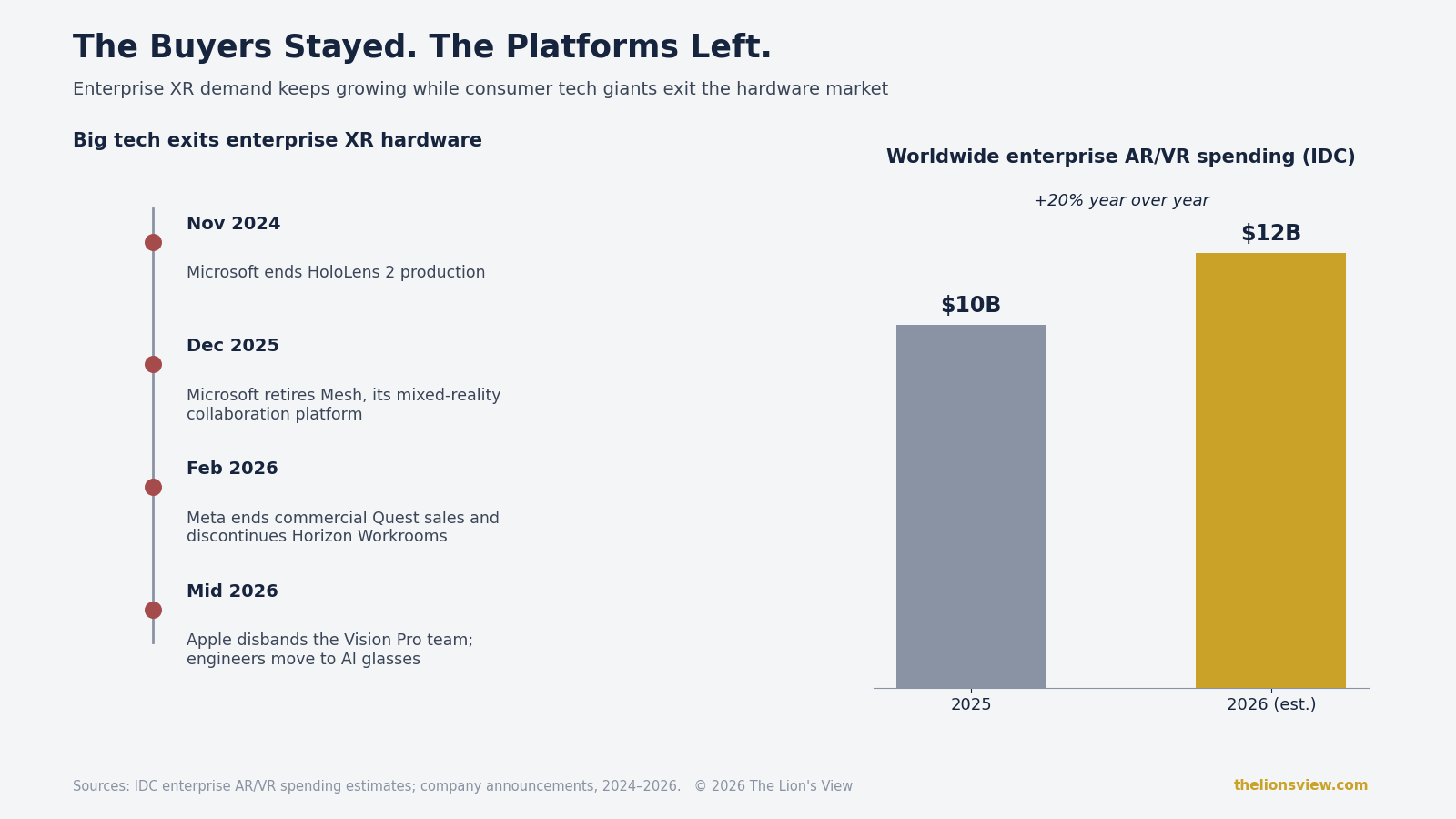
Three of the largest technology companies in the world spent the last decade building enterprise XR hardware programs. All three have now walked away. Microsoft ended HoloLens 2 production in late 2024, then retired Mesh, its mixed-reality collaboration platform, in December 2025. Meta shut down Horizon Workrooms in February and stopped selling commercial Quest devices the same week. Apple disbanded the Vision Pro team this summer and reassigned its engineers to AI glasses.
Here is what makes the moment worth studying. Enterprise spending on AR and VR did not drop. IDC estimates it will reach roughly $12 billion in 2026, up about 20 percent year over year, and roughly three quarters of the Fortune 500 run at least one active VR program.
The market did not fail. It changed owners. Any organization with XR in production, in pilot, or on next year’s roadmap now has to account for that shift, and most enterprise XR strategy documents written before 2026 are already out of date.
Why did the biggest names leave enterprise XR?
The consumer giants never treated enterprise XR as their core business. Meta’s hardware economics require consumer-scale volume. Microsoft’s HoloLens program depended on a defense contract that kept shrinking in scope. Apple built a $3,500 device still searching for its daily use case. When each company redirected capital toward AI, the enterprise XR portfolio was the first thing cut.
The vendors picking up the demand were built differently. Vuzix has shipped enterprise smart glasses for more than a decade and launched a packaged deployment portfolio in February with native Teams and Zoom support. RealWear builds intrinsically safe headsets for energy and industrial environments. Pico’s enterprise headset ships with a device-management suite and a published support roadmap that does not depend on a consumer division’s quarterly results.
What we’re seeing is a sorting, not a collapse. The hardware moved from companies that tolerated enterprise buyers to companies that depend on them.
What does the hardware shake-up mean for your XR roadmap?
Platform risk just moved onto the buyer’s side of the table. Organizations that standardized on commercial Quest devices got weeks of notice, not years. Training content built for Workrooms needed a new home within a quarter.
None of this changes the use cases that were already working. Simulation training for frontline and clinical workers, guided workflows on the factory floor, remote assistance for field technicians, immersive mission rehearsal in defense settings. Those programs continue because they answer to operational metrics, not to a platform vendor’s roadmap.
The practical implications are specific. Vendor viability now belongs in every XR procurement review, with financial durability weighted as heavily as optics or field of view. Support roadmaps should be in writing. Content should be built against OpenXR standards so it ports when a platform dies. Device fleets need the same identity, security, and endpoint management scrutiny IT applies to laptops. The AI/XR Due Diligence Checklist we publish covers the vendor-durability questions most procurement teams skip.
How do you know if your organization is ready to scale XR?
Hardware is no longer the constraint. Readiness is. A 2026 IEEE study of industrial XR deployments describes what its authors call the pilot trap: organizations run successful isolated pilots and then stall, not because the technology underperforms but because roles blur, incentives conflict, and nobody owns the KPI the program is supposed to move.
The sectors furthest along make the point. Health systems that moved simulation training into clinical onboarding did it by treating XR as workforce infrastructure, subject to the same credentialing and audit requirements as any other training system. Defense programs did the same with mission rehearsal. In both cases the budget owner was an operations leader, not an innovation office, and that single org-chart detail predicted scale better than any headset spec.
The pattern here matches what shows up in enterprise AI. Organizations that scale settle the governance questions before expansion. Who manages the devices. Who owns the content. What the security policy says, and who answers the support ticket at 2 a.m. Organizations that stall treat scaling as a bigger pilot.
That is the counterintuitive part. Scaling XR is a governance problem, not an innovation problem. Most organizations get the demo right and the operating model wrong.
How should you measure XR ROI?
Forrester’s 2026 Total Economic Impact update puts enterprise VR training ROI at 219 percent with payback under six months. Numbers like that deserve skepticism, and they hold up only where measurement was designed before deployment rather than reconstructed after.
The metrics that survive an audit are operational. Training time per certified worker. Error and rework rates. Equipment downtime avoided. Competency validation scores. Boeing, Delta Air Lines, and Chick-fil-A all report frontline training results in these terms, which is one reason their programs survived budget cycles that killed flashier pilots.
One second-order effect matters for budgeting. When training moves from a classroom to a headset, cost per learner falls with scale, but device management, content maintenance, and support costs rise alongside it. A credible ROI model carries both curves. Most pilot business cases only carry the first.
If a vendor’s ROI story leans on engagement scores or headset hours, keep asking questions. Usage is not outcome.
What should investors take from this?
For private equity, the exits create both risk and opening. Risk, because portfolio companies with XR-dependent products may be carrying platform exposure nobody priced at close. A company whose training product ran on commercial Quest devices had a distribution problem by March. Opening, because the specialized vendors filling the gap are growing into demand the giants abandoned, and consolidation in that vendor set looks likely over the next 24 months.
Diligence questions worth asking now: how much of a target’s revenue depends on a single hardware platform, whether its content is portable across runtimes, and whether management has a documented plan for the device refresh cycle. Our investor advisory work increasingly starts with exactly this exposure map.
The enterprise XR market just demonstrated something unusual: demand strong enough to survive the exit of the three biggest names in technology. Organizations that treat 2026 as the year to formalize XR strategy, rather than the year XR died, will hold a strategic advantage their competitors spend years matching.
If your organization is deciding where XR fits, how to scale it, or how to measure what it returns, our commercialization advisory practice works on exactly those questions.
References
- Apple, Meta, and Microsoft Are All Out of Enterprise XR Hardware (VR.org)
- Enterprise XR Trends 2026: From Pilot to Infrastructure (UC Today)
- Extended Reality in Business: XR Use Cases, ROI and Strategy (UC Today)
- Exploring Organizational Readiness and Ecosystem Coordination for Industrial XR (IEEE VRW 2026)
- XR and Spatial Computing Industry Statistics Report 2026 (Treeview)
Comments are closed