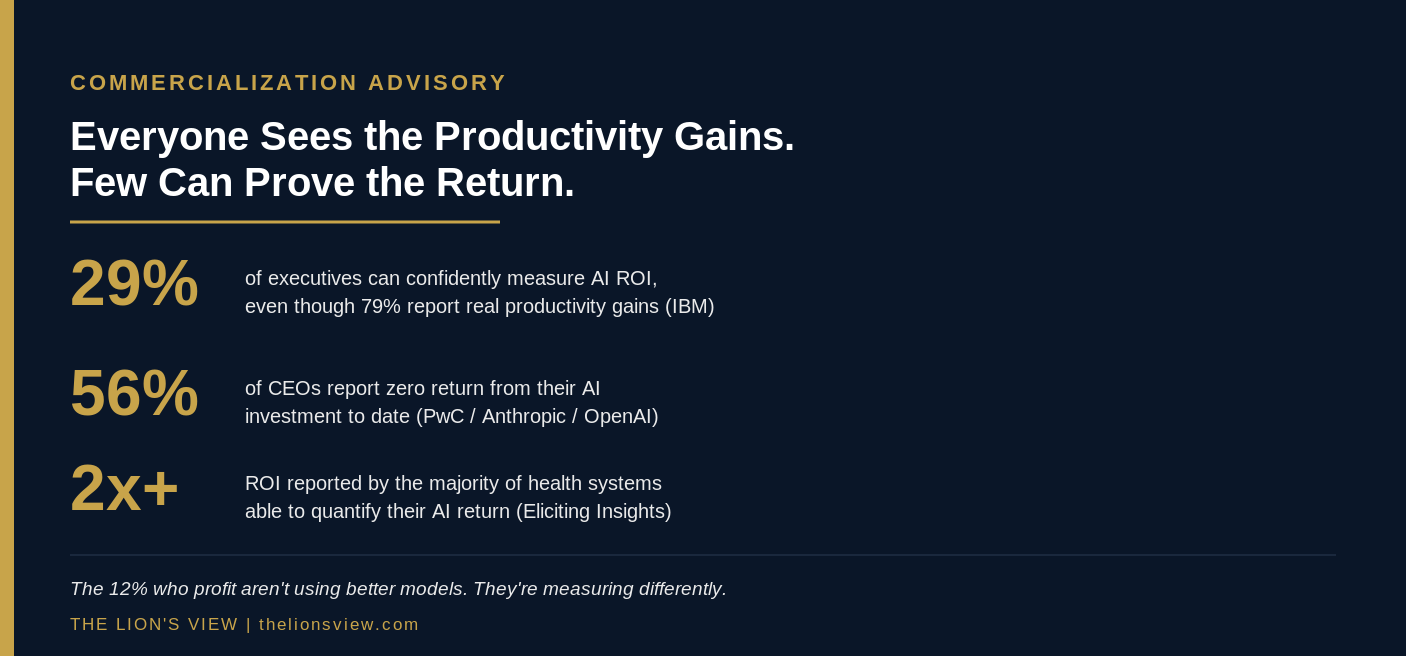
Worldwide AI spending is on pace to cross $2.5 trillion in 2026. Set against that number is an uncomfortable one from IBM: only 29% of enterprise executives say they can confidently measure AI’s return on investment, even though 79% report real productivity gains from it. Confidence in the technology has outrun confidence in the accounting.
That gap shows up everywhere we look — in board decks, in PE due diligence files, in CFO conversations about next year’s budget. It isn’t that AI doesn’t work. It’s that most organizations built their measurement approach for software that behaves predictably, and AI doesn’t behave that way. A traditional IT investment automates a task or it doesn’t. AI’s output quality shifts with the data feeding it, the workflow surrounding it, and the humans supervising it. Measuring it like a fixed-function tool misses most of what’s actually happening.
Why Do Most Enterprises Struggle to Measure AI ROI?
The pattern we’re seeing across enterprise engagements isn’t a measurement failure so much as a category error. Boards ask for a single ROI figure the way they’d ask for gross margin: one number, one line, one answer. AI value rarely compresses that cleanly. A model that cuts documentation time in half generates value in at least three places — the labor line, the error-rate line, and the retention line for staff who didn’t burn out and quit. Track only the first and the number looks modest. Track all three and it usually isn’t.
Deloitte’s research on enterprise AI puts the typical payback period at two to four years, well past the two-to-three-quarter horizon most finance teams are used to underwriting for technology spend. Only 6% of organizations report payback inside twelve months. Even among the top-performing cohort, that figure is 13%. A business case built on a one-year payback assumption is a business case built on an outcome almost nobody actually achieves.
Separate research compiling findings from PwC, Anthropic, and OpenAI adds a sharper data point: 56% of CEOs surveyed report seeing zero return from their AI investment so far. The minority who report meaningful returns aren’t running better models. They’re measuring differently — tracking specific factors like task complexity, decision autonomy, and success rate at the workflow level, rather than adoption alone, and tying deployment decisions to processes that were already instrumented before the AI arrived.
Why Doesn’t Standard IT ROI Modeling Work Here?
Traditional enterprise software ROI models assume a fixed function: automate task X, save Y hours, multiply by the loaded labor rate, done. That model assumes the tool performs the same way every time. AI systems don’t. Performance drifts as data distributions shift, as the workflow around the tool evolves, and as the people supervising outputs get better or worse at catching errors. A financial model built for static automation will consistently misprice returns from a system whose performance curve moves.
Consider a documentation assistant deployed at 90% first-pass accuracy across a 50-encounter pilot. Scaled to 5,000 encounters across a health system with more clinical variation and more specialty-specific terminology, that same tool’s accuracy can slide into the 70s before anyone notices. The ROI model built on pilot-stage numbers doesn’t survive contact with production scale. A readiness infrastructure assessment before scaling protects the ROI case as much as it protects the deployment itself.
What Does a Credible AI ROI Framework Actually Measure?
Frameworks holding up under board scrutiny in 2026 measure value across three layers, not one.
- Financial return: cost avoided, revenue attributed, and labor hours reclaimed at a fully loaded rate.
- Operational efficiency: cycle time, error rate, and throughput — the metrics that move before the P&L does.
- Strategic positioning: whether the deployment builds a capability a competitor can’t replicate quickly, or simply automates a task anyone could copy in six months.
This is the same lens we apply advising private equity clients evaluating AI-enabled targets ahead of close, using the same due diligence framework that governs how we assess claimed AI-driven margin expansion. A target claiming that expansion should be able to point to which of the three layers is generating it. Most management teams can point to one. Fewer can point to two. The ones who can demonstrate all three are usually the ones worth the valuation premium being asked.
What Does the Healthcare Data Show?
Healthcare is instructive here because it has been measuring AI’s return more rigorously, and for longer, than most other sectors. A February 2026 survey of 120 U.S. health systems by Eliciting Insights found 75% now use at least one AI application, up from 59% a year earlier, and half run three or more platforms concurrently. Among systems able to quantify return on their deployed AI, more than half reported at least 2x ROI.
The market context explains why rigor arrived here first. The FDA had cleared or approved roughly 1,250 AI- and ML-enabled medical devices as of last year, and the healthcare AI market is projected to grow from close to $39 billion in 2025 toward the mid-hundreds of billions by the mid-2030s. Regulatory clearance forced documentation discipline that unregulated enterprise software deployments never had to develop. Health systems didn’t start measuring ROI more rigorously by choice. Compliance requirements built the muscle first, and the ROI discipline followed.
The adoption data inside that same survey cuts against the obvious assumption that the best-performing use cases spread fastest. Clinical note-taking and ambient documentation adoption grew 62% year over year — the fastest-growing category in the survey. AI-based denial prediction, arguably the clearest dollar-for-dollar financial case of any use case measured, grew only 4%. Workforce relief is winning the deployment race even in categories where the ROI math favors something else. Anyone building a roadmap purely around projected dollar value should sit with that mismatch before finalizing a sequencing plan.
What Should Boards and Investment Committees Ask?
A short set of questions surfaces most of the gap between organizations that can defend their AI numbers and organizations that can’t.
- Which of the three value layers — financial, operational, strategic — is this figure actually coming from?
- What payback period is assumed, and does it hold up against the two-to-four-year norm now documented across enterprise deployments?
- Is the metric being reported an adoption metric, such as logins or usage counts, or an outcome metric, such as cost, cycle time, or error rate?
- Who owns the measurement after the pilot ends and the vendor’s implementation team leaves?
None of this argues against AI investment. Worldwide spend crossing $2.5 trillion says the capital is already committed. It argues for measuring that capital the way allocations of this size deserve: against outcomes, not adoption, and across a payback horizon grounded in what enterprises are actually experiencing rather than what a vendor’s pitch deck assumes. Skipping that discipline doesn’t just risk a wasted budget line. It risks a strategic misread — treating a defensible AI-enabled capability like a commodity feature, or walking away from real advantage because the dollar case wasn’t obvious in year one. Organizations that get the readiness infrastructure right before they scale tend to get the ROI question right once they do.
For enterprise and healthcare leaders building a defensible ROI case ahead of their next AI investment cycle, our commercialization advisory work starts with one question, asked before deployment rather than after: what, specifically, is this investment supposed to return, and how will the organization know when it has?
Comments are closed