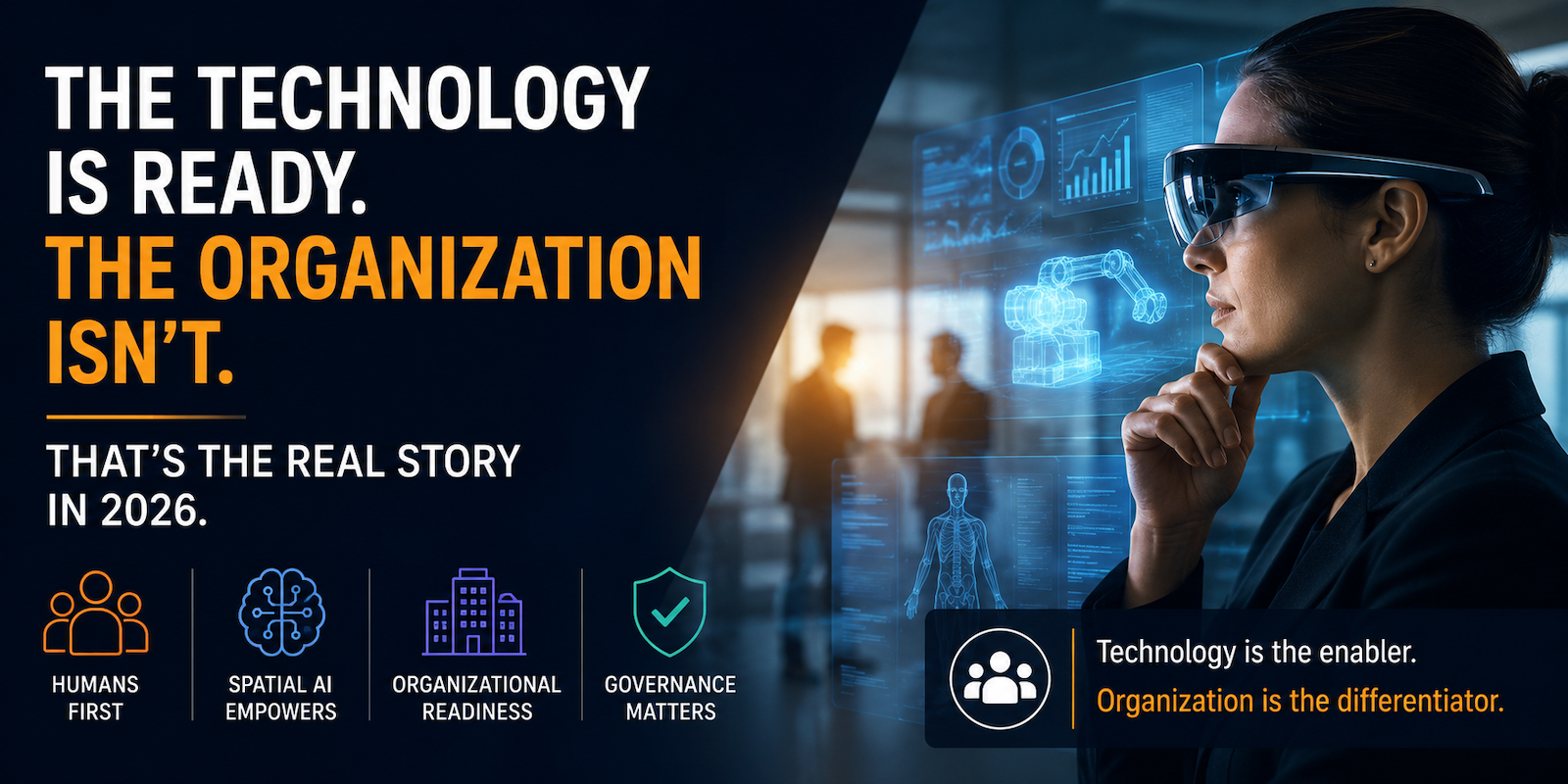
At AWE USA 2026, the dominant story isn’t what AI and XR can do — it’s what organizations aren’t prepared to absorb. Enterprises that have successfully scaled spatial computing share three common traits: change management built into the project scope from day one, internal champions who bridge operational and technical domains, and governance frameworks established before they’re needed.
AWE USA 2026 chose “I, Spatial: Humans Empowered by Spatial AI” as its conference theme. That word choice — empowered, not automated; humans first, not AI first — signals something worth paying attention to. Conference themes at events like AWE tend to reflect where the industry actually is, not where vendors want it to be. This one tracks.
The technology story is largely settled. AI and XR are converging in ways that would have seemed speculative three years ago. Smart glasses now process environmental context in real time. Adaptive training environments respond to how a person actually performs — not what a script assumes they should do. Physical AI and world models are beginning to close the gap between digital systems and real operating environments. The hardware roadmap is credible. The capability is real.
What isn’t settled is the organizational side. That’s the harder and more consequential conversation.
Why Do Enterprise XR and AI Deployments Fail at Scale?
The failure mode is almost never the technology. This pattern holds across healthcare, defense, manufacturing, and complex industrial operations.
Healthcare systems ran successful XR pilots for surgical training and clinical workflow optimization — and couldn’t scale them. Not because the technology broke down. Because the change management infrastructure wasn’t built to support adoption at scale. Defense contractors with genuine XR use cases in maintenance and complex assembly found that data integration with legacy systems consumed more time and budget than the deployment itself. Manufacturing organizations discovered that “deploying XR” is actually three separate problems: technical integration, workforce adoption, and the governance question of who owns and maintains the system once it’s live.
These aren’t technology failures. They’re organizational ones. And the distinction matters, because misdiagnosing the problem leads to the wrong remediation — more technology investment when the actual constraint is organizational readiness.
How Does AI Embedded in XR Systems Change the Governance Problem?
When AI is embedded in an XR system, the system is no longer static. It learns, adapts, and changes over time. That’s exactly what makes it valuable. It’s also what makes governance harder.
A traditional XR deployment has a known, fixed output. An AI-augmented XR system produces outputs that evolve — shaped by training data, usage patterns, and model updates that may not be visible to the operational teams depending on the system. The governance questions that follow are not theoretical: Who validates the AI’s recommendations? Who owns the training data? What happens when the system’s output conflicts with an experienced operator’s judgment? What’s the escalation path when the AI is wrong in a high-stakes context?
Those questions don’t have off-the-shelf answers. They require deliberate organizational thinking — structured before deployment, not retrofitted after the first incident. Organizations that treat governance as a post-launch problem tend to encounter it as a crisis instead.
What Do Organizations That Successfully Scale XR and Spatial AI Actually Do Differently?
The organizations getting this right share three observable characteristics.
First, they treat change management as part of the project scope from day one. Not a phase that follows go-live. Not a training session scheduled for the week before launch. Change management is scoped, resourced, and tracked alongside the technical implementation — because adoption failure is a delivery failure, regardless of whether the technology functions correctly.
Second, they identify internal champions who are fluent in both the operational domain and the technology. These are not IT leads who’ve attended a few XR demos, and they’re not operational managers handed a new system with a user manual. They’re people who can translate between technical capability and operational reality without oversimplifying either side. Finding or developing them is harder than procuring the platform. It’s also more determinative of outcomes.
Third, they build the governance framework before they need it. Not after the first incident surfaces a gap. Not when a regulator asks for documentation. The governance structure — covering model accountability, data provenance, change control, and human override protocols — is established as part of deployment architecture, not as an afterthought.
None of this is conceptually complicated. In practice, it requires executive commitment and an honest assessment of organizational readiness that most technology procurement processes never ask for.
What Is the Enterprise Conversation at AWE 2026 Actually About?
AWE’s enterprise footprint is larger this year than at any previous event. More than 300 enterprise and government organizations are represented at AWE USA 2026 in Long Beach, California. The conversations happening in dedicated enterprise spaces are increasingly about implementation reality — operational constraints, workforce considerations, accountability for outcomes. That’s a healthy maturation for an industry that spent a significant portion of the last decade overselling potential and underdelivering on scale.
The vendors on the expo floor will show you what spatial computing can do. That part of the conversation has genuine value. The harder conversation — the one that determines whether a deployment becomes a footnote in a lessons-learned document or a scalable operational capability — is about what your organization needs to be ready to absorb it.
The Implication That Doesn’t Get Enough Attention
Technology investment decisions and organizational readiness assessments are usually treated as separate workstreams. They shouldn’t be. The organizations with the most to gain from spatial AI are often the ones with the most organizational complexity standing between a pilot and a production deployment.
Procurement moves faster than transformation. That gap is where pilots stall, where governance gets improvised, and where the internal champions who should be leading adoption get reassigned before the work is done. Closing that gap isn’t a technology problem. It’s a leadership problem — and it has to be named as such before capital is committed.
The technology is ready. The question worth asking, before the next deployment decision, is whether your organization is. The Lion’s View provides independent AI and XR advisory for enterprise, healthcare, defense, and investor clients navigating consequential technology decisions. If this is the conversation you’re trying to have inside your organization, our Commercialization Advisory work is where it starts.
Frequently Asked Questions
What is the biggest reason enterprise XR deployments fail to scale beyond the pilot stage?
The most common cause is not technology failure — it’s organizational unreadiness. Specifically, the absence of change management infrastructure, the lack of internal champions who can bridge operational and technical domains, and governance frameworks that are built reactively rather than proactively. These are leadership and organizational design failures, not product failures.
What does organizational readiness for spatial AI actually require?
Organizational readiness requires three concrete elements: change management scoped into the project from the start (not added after go-live), internal champions fluent in both operational and technical domains, and a governance framework that addresses model accountability, data ownership, and human override protocols before the system goes live.
Why does embedding AI in an XR system make governance harder than a traditional XR deployment?
A traditional XR system has a fixed, known output. An AI-augmented XR system learns and adapts over time — which creates ongoing accountability questions that don’t resolve at launch. Who validates evolving outputs? Who owns the training data? What happens when AI recommendations conflict with experienced operator judgment? These questions require deliberate answers before deployment, not after the first incident.
How should enterprise leaders evaluate AI and XR investment readiness before committing capital?
Leaders should assess three things independently: technical integration complexity, workforce adoption capacity, and governance infrastructure. Most procurement processes evaluate only the first. The second and third are more determinative of whether a deployment produces measurable operational value — and more likely to be the source of failure if left unaddressed. The Lion’s View’s AI & XR Due Diligence Checklist outlines the specific questions to ask before capital moves.
What is The Lion’s View’s role in enterprise AI and XR decisions?
The Lion’s View is an independent AI and XR advisory firm serving enterprise, healthcare, defense, and investor clients. The firm’s role is not to sell or recommend specific technology platforms. It is to ensure that high-stakes technology decisions — deployment strategy, governance framework design, vendor evaluation, investment due diligence — are made with accurate, unbiased information before capital and reputation are at risk.
Comments are closed