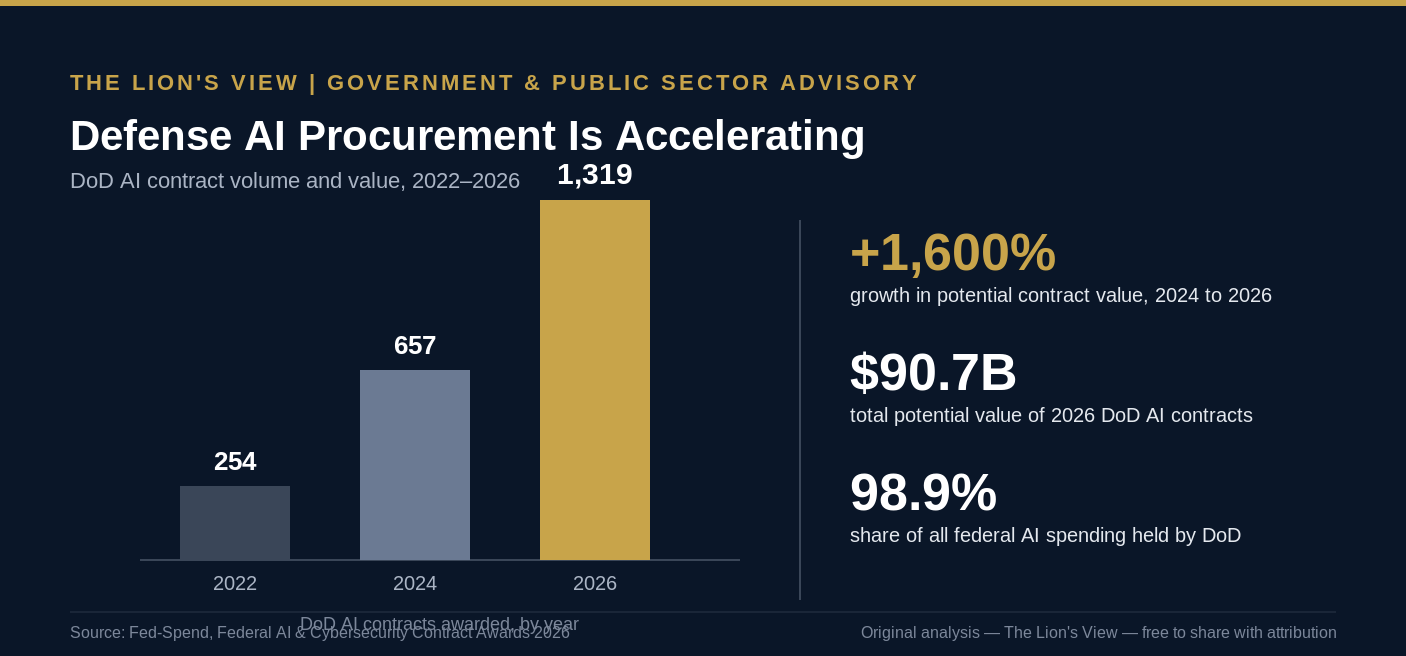
Defense AI contracts went from 657 in 2024 to 1,319 in 2026. Total potential contract value rose more than 1,600 percent over the same stretch, to roughly $90.7 billion — nearly 99 percent of all federal AI spending, according to contract-tracking data compiled by Fed-Spend. Two years ago, that same category numbered 254 awards.
That is not incremental growth. That is a market rebuilding itself around a single capability, faster than most of the institutions meant to evaluate it can keep pace.
What we’re seeing across defense programs right now is a split. One track is moving at commercial speed — Other Transaction Authority agreements, Commercial Solutions Openings, Portfolio Acquisition Executives managing capability areas instead of individual programs. The other track, the one built to verify that what’s being bought actually works, hasn’t been rebuilt at the same rate. The Pentagon’s own acquisition reform plan names “speed to capability” as the guiding metric. Congress, in signing off on the FY2026 NDAA, added a caveat: speed has to be weighed against cost, performance, lethality, and scalability. Both things are true at once, and that tension is where procurement risk now lives.
Why Is Defense AI Procurement Moving So Fast?
The mechanics are straightforward. OTAs and CSOs let program offices skip large parts of the Federal Acquisition Regulation that were designed for hardware programs measured in years, not model iterations measured in weeks. SOCOM, DIU, and DARPA have used these pathways for years; what’s different in 2026 is the scale of adoption across the services. The Army’s acquisition leadership has said publicly it is exploring expanding rapid acquisition authorities specifically to move faster on AI. Anduril’s $20 billion Linchpin award, Palantir’s Maven and Open DAGIR work, and the $800 million agentic AI award split across four frontier labs all moved through some version of this accelerated track.
None of that is a criticism of speed itself. A defense acquisition system that took five years to field a radar upgrade was never going to keep pace with adversaries iterating on autonomy and targeting software in months. The operational case for compression is real, and it’s the correct call in a fair number of these programs.
There’s a second effect worth naming. OTAs and CSOs were built to attract nontraditional suppliers — companies that never would have survived a two-year FAR-based source selection. That’s largely working. It also means program offices are evaluating a wider mix of vendors, including some without a decade of past-performance history to check against, on a faster clock than the one traditional primes were held to. Speed and vendor unfamiliarity arriving together is exactly the combination that makes independent evaluation matter more, not less.
What Happens When Evaluation Doesn’t Keep Pace?
The risk shows up downstream, in the evaluation step itself. In August, Trax International filed suit alleging that the Army used an AI tool to help evaluate its bid on a $450 million White Sands Missile Range contract — and that the tool flagged a “weakness” in the proposal that no human on the Source Selection Evaluation Board ever verified. The finding reportedly moved roughly $29.4 million in perceived value toward the winning bidder. GAO denied Trax’s protest in May. This is the second such allegation to surface in 2026, after a similar claim from Salient CRGT in January.
Two data points don’t make a trend. But they point at something structural: few civilian or defense agencies currently report AI use in bid evaluation as “high-impact” under existing risk frameworks, which likely means one of two things — either minimum risk practices genuinely haven’t been implemented for this use case, or they have been and simply weren’t disclosed. Procurement offices adopted AI to speed up the parts of acquisition everyone agrees are too slow. Nobody built the audit trail for the parts that decide who gets the money.
The NDAA’s Answer, and Its Timeline
Congress addressed this directly in the FY2026 NDAA. The Secretary of Defense is required to stand up a cross-functional team to assess AI models by June 2026, and that team must produce a department-wide assessment framework — covering model performance standards, testing procedures, security requirements, and principles for ethical use — by June 2027. The same legislation tightens supply chain restrictions tied to adversary-nation sourcing; the Pentagon has already labeled at least one AI vendor a supply chain risk over its refusal to support autonomous weapons and domestic surveillance use cases, a decision with implications well beyond that one contract.
The honest read on that timeline: the framework arrives roughly a year after this current wave of contract awards. Programs signing OTAs and CSOs today are not waiting for June 2027 guidance. They are making procurement decisions against a standard that doesn’t exist yet, which is precisely the gap an independent review is built to close in the meantime.
What This Means for Programs Evaluating AI Vendors Now
For program managers, contracting officers, and agency leadership moving on AI procurement ahead of the department-wide framework, five checks matter more than the rest:
- A named human owns every evaluation decision that touches award outcomes. If AI tools assist bid or proposal evaluation, a specific person on the Source Selection Evaluation Board signs off on each AI-flagged finding before it affects scoring — not after a protest is filed.
- Testing and validation evidence exists now, not on the 2027 timeline. Waiting for the NDAA-mandated framework to arrive before applying performance and security standards leaves eighteen months of awards without a consistent bar.
- Supply chain provenance is documented, not assumed. Adversary-nation sourcing restrictions apply to models, training data, and infrastructure partners, not just the prime contractor’s cap table.
- A funded transition path exists beyond the pilot. Federal AI programs stall for identifiable, repeatable reasons — the authorization-to-operate cliff, unresolved CUI data scope, legacy-system integration debt, and color-of-money mismatches between prototype and sustainment funding chief among them.
- The use case has named end users before it has a contract number. CJADC2’s minimum viable capability runs on 90-day experimentation cycles with named users and funded transition built in from day one. That structure is the exception in federal AI right now, not the rule.
None of these five checks require slowing the acquisition down to the old FAR timeline. They require someone outside the program office and outside the vendor relationship — with no stake in the award closing on schedule — running the checklist before signature, not after a protest forces the question. That’s a different function than the contracting officer’s, and a different function than the vendor’s own compliance team. It’s closer to what a technical advisor does in a PE diligence engagement, applied to a procurement decision instead of an acquisition target.
The Pattern Worth Naming
RAND’s 2025 research on enterprise AI found that 80.3 percent of projects fail to deliver the business value promised at kickoff — a third abandoned before reaching production, another quarter reaching production but underperforming, the rest running without ever recovering the investment. Those numbers describe commercial deployments broadly, not defense programs specifically. But the federal-specific failure modes researchers have documented this year — the ATO cliff, CUI scope discovery, no funded production path — are a narrower, sharper version of the same underlying problem: organizations are absorbing AI faster than their governance structures can verify it.
Speed and rigor are not actually opposites. CJADC2 proves that a 90-day cycle and a funded transition plan can coexist with genuine acceleration. What separates programs that scale from programs that stall out or draw a GAO protest isn’t the acquisition pathway they used. It’s whether someone independent checked the work before the money moved, not after.
For defense and public-sector leaders weighing AI procurement decisions under this timeline, our Government & Public Sector Advisory practice and AI & XR Due Diligence Checklist are built for exactly this gap — and The DoD AI-First Mandate covers the broader readiness picture behind this shift.
Sources
- Fed-Spend, “Federal AI and Cybersecurity Contract Awards 2026”
- Defense One, “Did AI blow a $450M Army contract decision? Company lawsuit says yes” (Aug 2026)
- Nextgov/FCW, “Contractor alleges Army inappropriately used AI to make $450M contract award” (Aug 2026)
- King & Spalding, “FY 2026 NDAA: Domestic Sourcing, Artificial Intelligence, Cybersecurity, and Acquisition Reforms”
- IDGA, “Five Takeaways from the Pentagon’s Sweeping Acquisition Reform Plan”
- Truvisory, “Why Federal AI Pilots Stall — Scope One That Ships (2026)”
Comments are closed