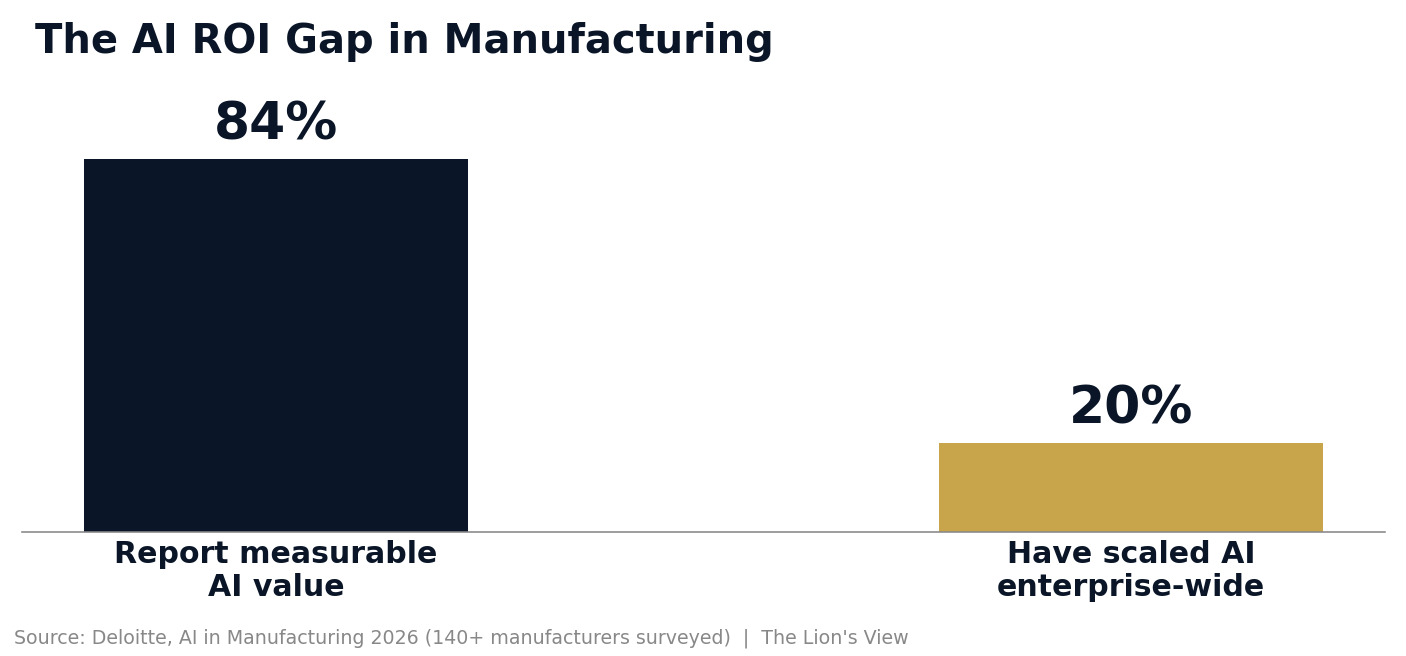
Eighty-four percent of manufacturers now report measurable value from AI somewhere in their operations. That’s the headline finding from Deloitte’s 2026 survey of more than 140 manufacturing organizations, and on its face it reads like an adoption success story. Look one line further into the same report: only one in five of those use cases has actually scaled beyond the pilot that proved it out.
That gap is where most of my commercialization advisory conversations end up. Not whether AI works on a shop floor — it does, and the evidence is no longer thin. The real question is why proof of concept so rarely becomes enterprise-wide practice, and what separates the manufacturers who cross that line from the ones re-running the same pilot in a different building.
Why do manufacturing AI pilots stall before they scale?
The operational reality isn’t a technology problem. Deloitte’s respondents name implementation cost first, at 43%. A shortage of technical expertise and plain resistance to change tie at 35% each. Regulatory and compliance concerns show up at 34%, data availability and quality at 30%. None of those five barriers is a model performance issue.
- Implementation cost — 43% of manufacturers name this the primary barrier to scaling AI past a pilot.
- Lack of technical expertise — 35%.
- Resistance to change on the floor — 35%.
- Regulatory and compliance concerns — 34%.
- Data availability and quality — 30%.
Every one of those five is organizational. I’d add a sixth, less visible but just as common in what we’re seeing directly with manufacturing clients. A pilot proves a use case works on one line, with one data set, under conditions someone spent months cleaning up to make the demonstration look good. Scaling requires the same result on equipment that wasn’t part of the pilot, validated by people who didn’t build it, under data conditions nobody curated in advance. That’s a different exercise entirely. Most AI budgets are still structured to fund the first one, not the second.
Where is AI actually earning its keep on the floor?
Adoption isn’t spread evenly, and it shouldn’t be. Quality leads at 62%, production at 57%, logistics and supply chain at 49%. The pattern is economically rational rather than accidental — these are the areas with the richest sensor and process data, the clearest line to a KPI, and the fastest path to a defensible dollar figure. Assembly shows the strongest improvement potential in discrete manufacturing, at 22%. Chemical and physical transformation processes hit 32% in process manufacturing. Equipment availability, maintenance cost per unit, energy consumption per unit, and cycle time all cluster in a 21% to 27% improvement band across the survey.
Manufacturers who spread AI evenly across the enterprise, hoping breadth will substitute for depth, are the ones I watch stall. The ones who scale pick two or three processes where complexity and business value genuinely intersect. They build fluency there first. Only then do they move to the next one. It’s a narrower bet than most steering committees are comfortable making, and it wins more often than the broad one.
What’s changing: from point tools to closed-loop systems
The technology mix is shifting underneath this pattern. Machine learning and deep learning still lead Deloitte’s survey at 42% of deployments. Generative and agentic AI sit close behind at 40%. Physical AI — systems that act directly inside the production environment rather than simply recommending an action to a human — accounts for 18% and is climbing. That last category changes the risk conversation entirely. A model that flags an anomaly for a technician to review carries one kind of exposure. A model that adjusts a feed rate on a live line carries another.
That shift shows up directly in how manufacturers describe risk. Seventy-nine percent cite operational disruption as their top concern with AI in production, ahead of cybersecurity at 51%. Compliance exposure and system reliability round out the list. As AI moves from advisory to autonomous, algorithm accuracy stops being the binding constraint. Trust, validation, and the ability to explain a decision after the fact become the real gating factors. It’s the same organizational readiness gap I track across every sector, just measured here in stamping presses and vibration sensors instead of claims data or classified networks.
Who should own the rollout — and why that choice predicts the outcome
Industry analysis of failed 2025 manufacturing AI pilots, compiled by Factory AI’s 2026 benchmarking, points to a structural pattern that has nothing to do with which vendor was selected. Projects led solely by IT departments failed roughly 60% of the time. Projects led by cross-functional teams — maintenance managers paired directly with IT — succeeded at a rate closer to 85%. When operational technology expertise isn’t in the room to contextualize what the data actually means on the floor, models produce results that are technically accurate and operationally useless.
The same split shows up at the technician level. In facilities where the floor wasn’t told why a system was going in, adoption stayed thin. In facilities where technicians helped place sensors and shape the dashboard, adoption climbed sharply. A model nobody trusts gets quietly routed around, no matter how accurate it is. That’s not a training problem to solve after deployment. It’s a design decision that has to be made before the first sensor goes up.
How should a plant measure ROI instead of counting pilots?
Pilot count is a vanity metric. It shows activity, not value. The manufacturers getting this right anchor to a small number of KPIs tied directly to cost or revenue — equipment availability, scrap rate, cycle time, energy per unit — and they track the same handful across every site running the technology rather than inventing a new scorecard per plant. That consistency is what makes a result defensible in front of a CFO. It’s also what turns a single-site win into a template other plants can adopt without re-litigating whether the technology works in the first place. This is the same discipline behind the ROI framework I use with enterprise clients regardless of sector: fewer metrics, tracked consistently, tied to dollars from day one.
What has to be in place before a manufacturer scales AI enterprise-wide?
Three things, consistently, across the clients and case data I work through.
- A data foundation solid enough that a use case built on one line can be trusted on another line — most manufacturers aren’t there yet, which is exactly why 30% still name data quality a primary barrier.
- A governance and validation process that doesn’t depend on one engineer’s memory of why the model works the way it does.
- A rollout template — common architecture, common validation steps, common documentation — built once and reused rather than reinvented plant by plant.
None of that is exciting work. It’s also the entire distance between the 84% who’ve proven AI creates value and the 20% who’ve proven it scales.
The manufacturers who close that gap first won’t be the ones running the most advanced models. They’ll be the ones who treated the second pilot’s job — proving the first one generalizes to a plant nobody built the demo for — as seriously as the first. For manufacturing leaders trying to work out where that investment will compound rather than stall in pilot purgatory, that’s the question our commercialization advisory practice is built to answer.
Comments are closed