Matt Holt’s Thoreau Group agreed this year to pay $12 billion for Ensemble Health Partners, a revenue-cycle management platform built on AI-driven denials and prior-authorization automation. It was one of 115 digital health acquisitions Rock Health counted in the first half of 2026 alone, a pace already closing in on 2025’s full-year total of 199 and well past 2024’s 121. Every one of those transactions ran an AI-enabled target through some version of technology diligence. Few of those processes were built to ask what a healthcare AI asset actually requires.
The reality is that most technology due diligence templates in circulation right now were written for software, not for AI embedded inside a regulated clinical or reimbursement workflow. They test licensing terms, infrastructure spend, and code quality. They do not test whether a model’s marketed accuracy rate would survive an IRB’s scrutiny, whether the “proprietary AI” is a wrapper around a foundation model with undocumented training data, or whether the clearance pathway behind a clinical claim was ever pursued at all. A diligence process that skips those questions can clear a target that becomes a liability the operating partner inherits at month eighteen, not at close.
Why Generic Tech Diligence Misses Healthcare AI Risk
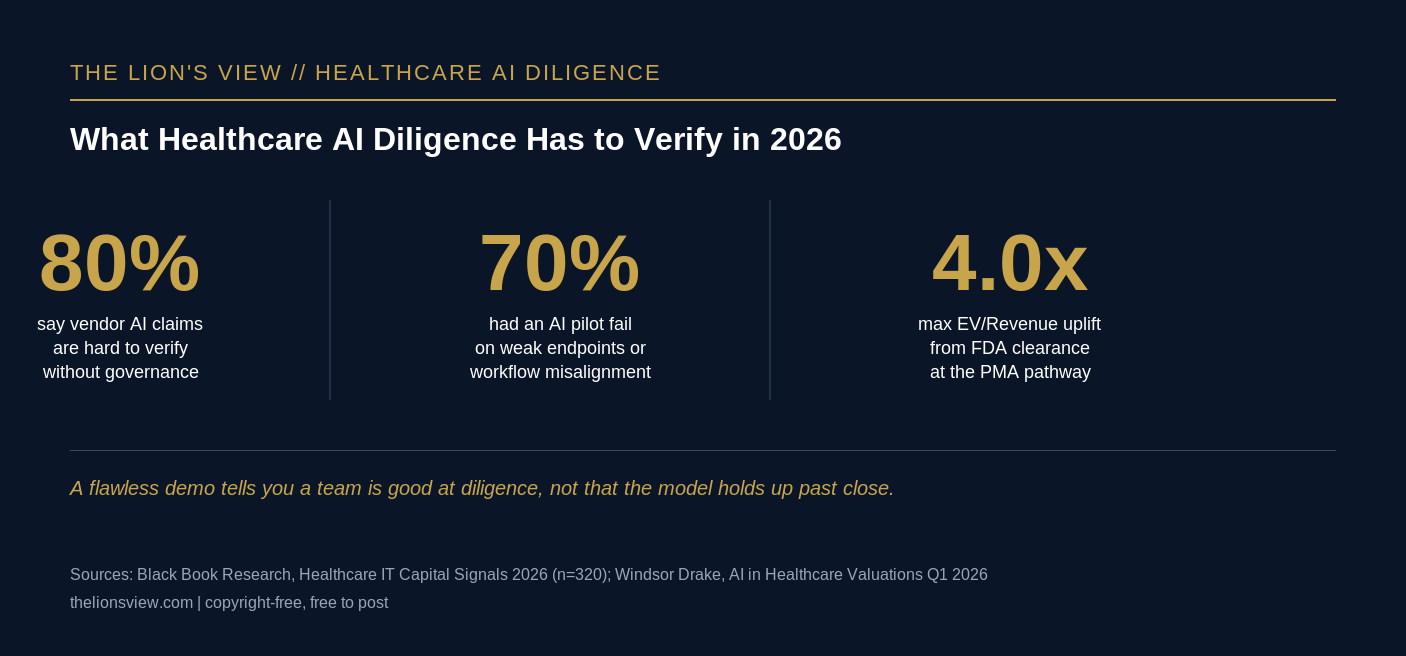
Windsor Drake’s Q1 2026 valuations research put a number on what regulatory pathway does to price. FDA clearance through the 510(k) or De Novo route adds roughly 0.5x to 1.5x on EV/Revenue; PMA approval for higher-risk Class III devices adds another 2.0x to 4.0x. Platforms carrying peer-reviewed randomized controlled trial data alongside that clearance trade at two to three times the multiple of unvalidated peers. That is not a marketing distinction. It is the gap between a defensible asset and a target whose valuation premium rests on a claim nobody outside the company has independently tested.
EHR integration depth carries its own premium in the same research — 1.5x to 2.0x for platforms with genuine Epic or Cerner-native integration over standalone portals that require a separate clinician login. None of that shows up if a diligence checklist only asks whether a product “integrates with the EHR,” rather than testing whether that integration is a certified interface or a fragile, point-in-time build that breaks the moment one vendor contract changes.
What 2026 Data Says About the Governance Gap
Black Book Research surveyed 320 investors, bankers, and healthcare technology leaders at this year’s VIVE and JP Morgan Healthcare Conferences for its Healthcare IT Capital Signals report. Eighty percent said vendor AI claims are difficult to verify without formal governance structures in place. Seventy percent had lived through at least one failed AI pilot caused by weak endpoints, workflow misalignment, or data gaps — not a model that failed in a lab, but one that failed to survive contact with an actual clinical or revenue-cycle workflow. Eighty percent named EHR, AI, and cloud vendors as the largest emerging source of cyber risk, and 69% had already experienced a vendor-traceable security incident or near miss in the past two years.
That is the governance question a diligence team has to answer before close. Not whether the target has a compliance policy on file. Whether anyone there can produce, on request, the model’s training data lineage, its last documented drift event, and the name of the person accountable for catching the next one.
The Counterintuitive Signal in Healthcare AI Deals
Here is what should concern an investment committee more than a rough demo: a target whose AI performs flawlessly in every diligence session. The same Black Book research found unit economics clarity (65%), reimbursement pathway confidence (61%), and clinical evidence quality (55%) are now baseline underwriting requirements, not differentiators. Founders know what a fund wants to see, and the better-resourced ones build a data room around exactly that. A smooth demo tells you a team is good at diligence. It does not tell you the model holds up against a denials queue it has never seen, staffed by clinicians it has never trained.
Rock Health’s H1 2026 analysis captured a related shift on the venture side. Aidoc closed a second $150 million round backed by General Catalyst and NVIDIA’s venture arm in under a year, while OpenEvidence closed $250 million. Capital is concentrating on platforms with documented clinical deployment and defensible data moats, not proof-of-concept demos — as Rock Health’s researchers put it, investors are no longer asking who has AI, but who has something AI alone cannot provide. That is the same standard a healthcare AI diligence framework has to apply at the buyout stage. The difference is a venture investor gets to watch a platform prove itself across several funding rounds. A PE diligence team gets one data room and thirty to sixty days.
Five Questions a Healthcare AI Diligence Framework Has to Answer
Five questions belong ahead of the financial model in any healthcare AI-specific diligence process:
- Regulatory pathway and clearance status — 510(k), De Novo, or PMA, and whether the clearance actually covers the use case being marketed, not an adjacent one.
- Clinical validation depth — peer-reviewed outcomes data versus internal benchmarks the vendor generated and graded itself.
- Data provenance and HIPAA posture — where patient data lives, under what business associate agreement, and what breaks if that agreement is renegotiated post-close.
- EHR integration architecture — a certified, maintained interface versus a custom build that depends on one engineer’s relationship with the health system’s IT team.
- Workforce and workflow dependency — which clinical or revenue-cycle staff the tool displaces or depends on, and what the transition plan looks like in the first twelve months.
None of these five appear on a standard 2019-era technology diligence template. All five now belong on page one.
Faster Diligence Is Not the Same as Verified Diligence
The temptation is to assume AI-accelerated diligence tools solve this problem on their own. Industry research on generative AI in M&A points to deal teams completing document review and data-room synthesis 30 to 50% faster when AI tools are applied to the process. That speed is real, and firms are right to use it. It also has nothing to do with whether a clinical AI system holds up in production. Faster document review answers how quickly a team can read a data room. It does not answer whether a model’s claimed accuracy rate survives contact with a real denials queue, or whether the clearance behind a clinical claim actually covers the use case being sold.
Conflating those two questions is how an overstated AI claim survives a compressed thirty-day process that a slower, more deliberate six-week process would have caught. The firms treating AI-accelerated review as a replacement for clinical and regulatory verification, rather than a complement to it, are the ones most likely to discover the gap after close rather than before it.
What This Means for Investment Committees
The firms getting this right are not running faster diligence. Bain’s research already puts the technology-acquisition failure rate at 62% against original financial targets, with weak technical diligence as the leading cause — a number that gets worse, not better, when the target’s core asset is a regulated AI system instead of a database migration. Faster document review helps a fund process a data room. It does not tell a fund whether what is inside that data room survives past close.
The next two years of healthcare AI M&A will separate funds that treat clinical and regulatory validation as a specialist workstream from funds that fold it into the standard tech diligence checklist and hope the reviewer catches what matters. That distinction will not show up in the deal memo. It will show up eighteen months post-close, when the value-creation plan either holds or unwinds.
Healthcare AI due diligence is one thread of The Lion’s View’s investor advisory work — separating what a healthcare AI target claims from what its clinical and regulatory record can support before capital moves. Our AI & XR Due Diligence Checklist and our earlier look at scaling healthcare AI from pilot to production cover the adjacent ground: what a healthcare AI platform has to survive after the deal closes.
The evaluation framework behind this checklist, including how these dimensions apply across deal stages, is set out in full in The AI Due Diligence Framework for Private Equity.
Comments are closed