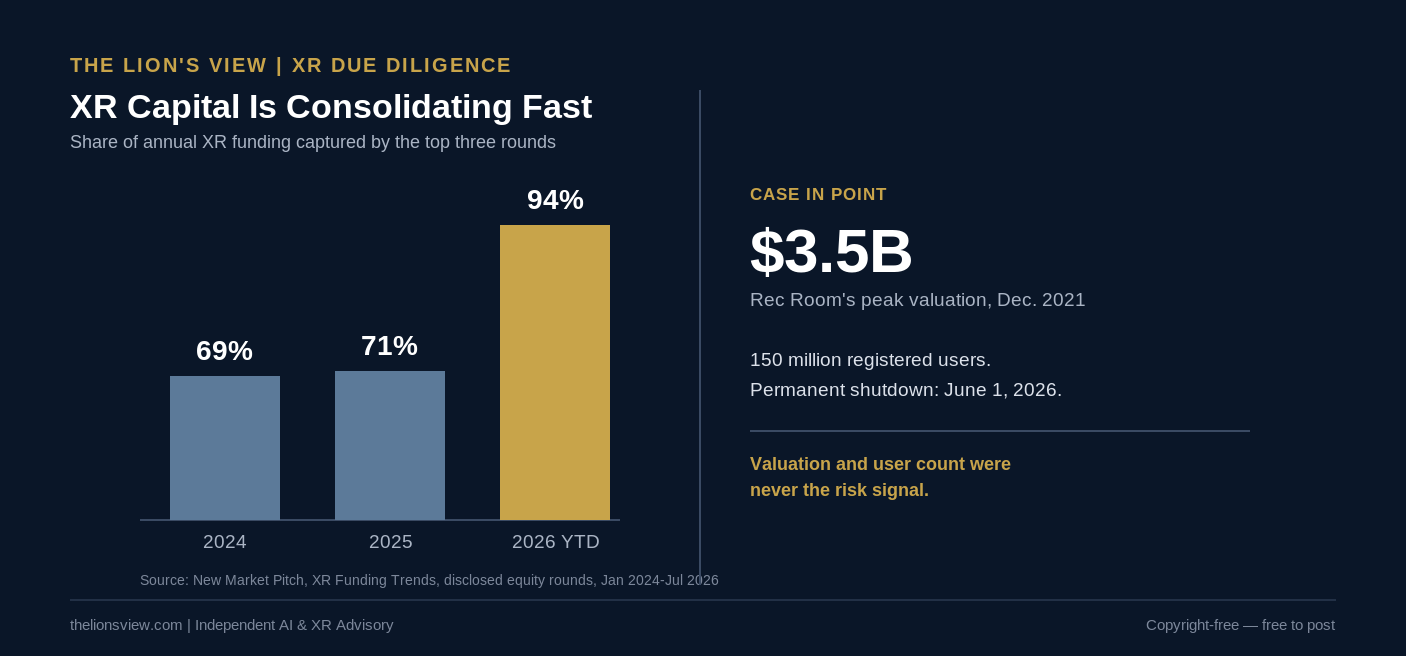
Rec Room raised $294 million, reached a $3.5 billion valuation in December 2021, and registered 150 million users. On June 1, 2026, it shut down for good. Every metric a standard diligence process checks — capital raised, valuation trajectory, registered users — pointed the right direction until the day the company announced it was finished.
That gap is the operational reality private equity firms and corporate development teams now have to underwrite. XR targets rarely fail the demo. What we’re seeing is that they fail the question nobody asked in the data room: does this business survive without its current owner’s balance sheet, and does the technology answer to an operating metric or to a valuation narrative?
Why do well-funded XR companies still fail?
Magic Leap raised $3.48 billion across twelve rounds between 2014 and 2024 — more than any independent XR hardware company in history. Its most recent round, $590 million in 2024, came structured as debt from Saudi Arabia’s Public Investment Fund rather than equity. That structure is itself a signal. Equity investors had priced in enough downside that they preferred creditor status to ownership.
Meta’s Reality Labs division tells a related story at a different scale. Cumulative operating losses since 2020 now stand near $83.6 billion, and in late 2025 Meta began shifting resources away from Horizon Worlds toward AI glasses. We covered the hardware side of this shift in our review of the 2026 enterprise XR hardware shake-out, when Microsoft, Meta, and Apple all exited enterprise XR hardware programs within fourteen months of each other, even as enterprise XR spending kept climbing. A company with Meta’s balance sheet absorbs a loss like that. A portfolio company cannot. A diligence process built only around whether the technology performs will miss both failure modes, because the technology was never what broke.
What does the 2026 capital data tell diligence teams?
XR funding concentration has become severe enough to change how a target should be read. New Market Pitch’s tracker of disclosed XR equity rounds shows the top three rounds captured 69 percent of 2024 capital, 71 percent in 2025, and 94 percent through the first half of 2026. The average XR round in 2025 was $42.5 million. The median was $11.4 million. Most companies in this sector are not living the story that average implies.
AR glasses alone captured 75 percent of 2026 year-to-date XR capital. Enterprise XR software, by contrast, produced the most deals of any category in 2025 — six — while raising $182 million, less than a third of what AR glasses pulled in during the same period across fewer rounds. Sitting outside the AR-glasses thesis does not disqualify a target. It does mean the capital markets have already signaled that a second round will not come on narrative alone, and revenue quality has to carry the rest of the case.
What happens when a strategic buyer takes a hard look?
CoStar Group’s acquisition of Matterport is the cleanest recent illustration of that repricing. Matterport went public via SPAC in 2021 near a $3 billion valuation, built on its 3D spatial data platform for real estate. CoStar, a real estate data company with no reason to overpay for optionality, acquired it in 2024 for $1.6 billion. That is not a company that failed outright. It is a business a disciplined acquirer repriced against actual revenue and integration value once the SPAC-era multiple came off the table. Any diligence process should assume the next buyer will run the same math CoStar did — not the math the last funding round implied.
What should an XR due diligence checklist actually test?
The technology review most teams already run is necessary and not sufficient. Five questions carry more predictive weight than a product demo:
- Vendor durability. Does the hardware or platform vendor have a balance sheet built to survive a two-year gap between funding rounds, and did its most recent round come structured as equity or as debt?
- Platform dependency. Is content and workflow data built to OpenXR or another portable standard, or does the business depend entirely on one vendor’s proprietary SDK?
- Revenue quality. What share of revenue comes from recurring enterprise contracts tied to an operating outcome, versus one-time device sales or unrenewed pilot fees?
- Governance and measurement. Who owns the ROI metric internally, and was it defined before deployment or reconstructed afterward to justify the investment already made?
- Category exposure. Does the target sit inside AR glasses, enterprise workflow, or medical and simulation categories, where 2026 capital is actually flowing — or outside them, where the next round depends on revenue alone?
The AI & XR Due Diligence Checklist we publish walks through these categories in more depth, with the specific questions to raise in management meetings rather than just the data room.
The same lens applies before an enterprise signs a vendor contract, not only before a fund signs a term sheet. An operations team evaluating an XR training vendor is running a smaller version of the identical diligence: does that vendor’s balance sheet survive a slow sales cycle, and does the training content port to a new device if the vendor exits the category the way Microsoft, Meta, and Apple’s consumer divisions just did. The stakes are lower than a control investment, but the failure mode is the same one Rec Room’s users discovered in June.
How does this connect to the broader enterprise XR build-out?
None of this argues against XR investment. It argues for underwriting XR investment correctly. Enterprise XR software funding grew from $31 million in 2024 to $182 million in 2025, and the category producing the most deals also has the clearest path to recurring revenue: training, device management, and workflow software sold against a budget an operations leader already controls. That is a materially different risk profile than a hardware platform waiting on its next round, and a diligence framework has to score them differently rather than run both through the same checklist.
Here is the counterintuitive part. The companies attracting the most capital right now — AR glasses makers pulling in 75 percent of 2026 dollars — are not automatically the safer bet for a PE firm running a five-to-seven-year hold. They are the safer bet for a venture investor betting on category winners. A private equity firm underwriting cash flow should weight enterprise workflow and vendor-durability signals more heavily than headline funding momentum, because those signals correlate with the metric that actually matters at exit: whether the business generates revenue an acquirer will pay for on its own terms.
What should investors do differently starting now?
Bake vendor durability and revenue-quality tests into the term sheet itself, not just the diligence memo. Ask for the full round-structure history, not only the valuation history — a shift from equity to debt financing is a clearer signal than any headline number. Treat category exposure as a real, priced risk factor: a target outside AR glasses or a regulated enterprise workflow is not disqualified, but it is carrying capital-market risk the checklist should name explicitly rather than assume away.
The XR sector is not short on capital. It is short on companies that can explain, in operational terms, why the money that already found them will keep finding them. That was the diligence question that mattered before Rec Room shut down its servers, and it is the one that will separate the next decade’s winners from the funding rounds that made headlines and little else.
For firms building this into a formal evaluation process, our investor advisory work walks through how to weight these signals against a specific target before capital moves.
For how this plays out once an XR deployment moves past the demo stage, see Enterprise Spatial Computing Implementation: What Comes After the Demo.
Comments are closed