By Lynn Welch | The Lion’s View
In January 2026, the Secretary of Defense issued a memo that redefined the Department’s relationship with artificial intelligence. Not in aspiration — in execution. The 2026 AI Acceleration Strategy doesn’t describe where the DoD wants to go with AI. It describes what the Department is now doing, at what speed, and what will no longer be tolerated as an excuse for delay.
Four months into implementation, what we’re seeing confirms what the document promised. This is a structural shift in how the U.S. military acquires, deploys, and operationalizes AI — and it has immediate implications for defense contractors, AI vendors, program managers, and the organizations still mapping out their AI readiness plans.
The Operational Reality of the New Directive
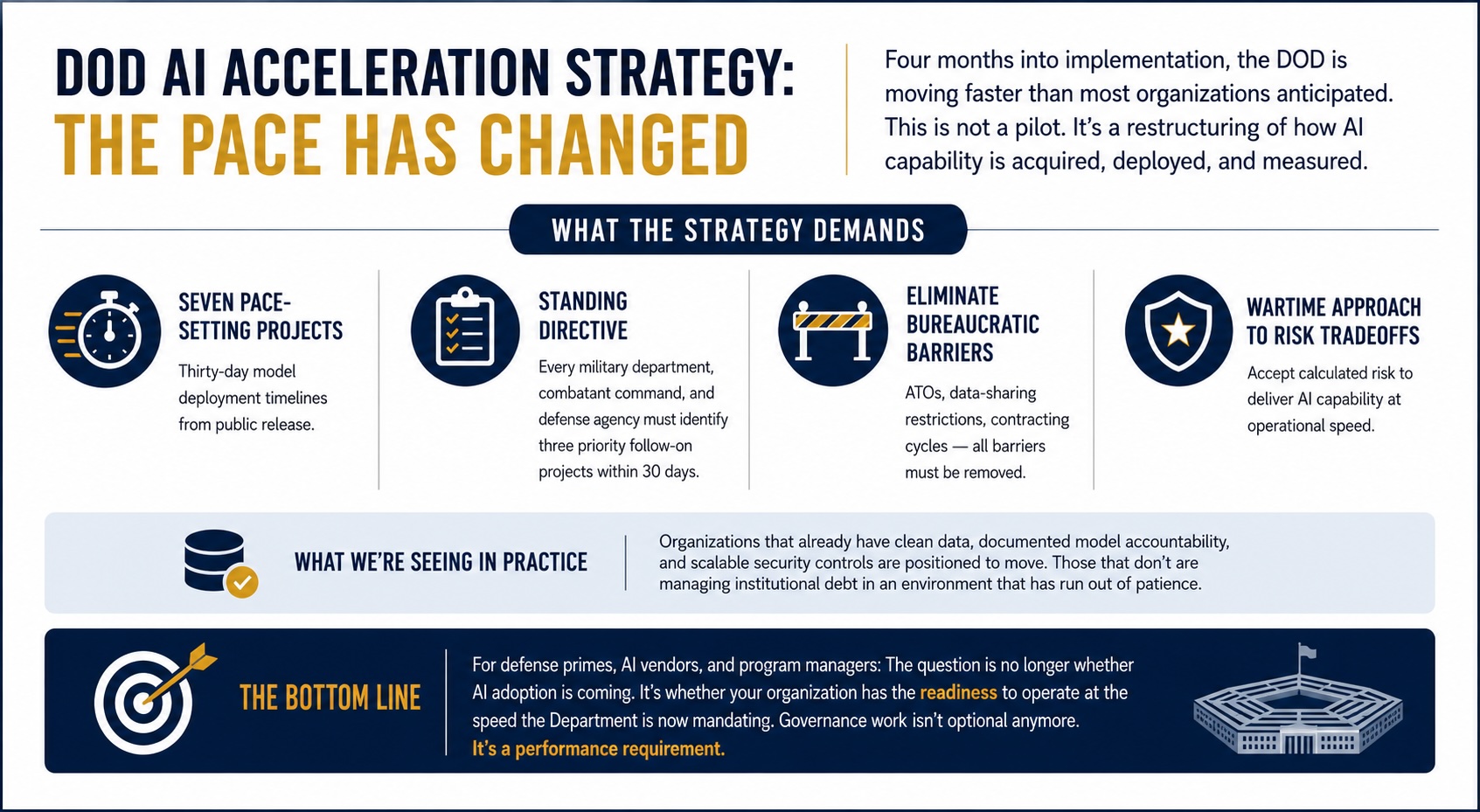
The 2026 strategy establishes seven Pace-Setting Projects (PSPs) administered by the Chief Digital and AI Office. Each PSP carries a clear mandate: single accountable leaders, aggressive timelines, measurable outcomes, and rapid iteration. The language in the memo is explicit — failure is expected to accelerate learning, not halt progress.
The policy further requires every military department, combatant command, and defense agency to identify at least three priority follow-on projects within 30 days of the PSP launch. And it mandates that AI vendor partnerships allow the latest models to be deployed within 30 days of public release — a compression of procurement timelines that would have been unthinkable under legacy acquisition frameworks.
The strategy names its targets explicitly: data-sharing barriers, Authorization to Operate (ATO) delays, test and evaluation bottlenecks, contracting cycles, and talent hiring constraints. The memo’s framing is clear — these are no longer acceptable operating conditions. They are problems to be eliminated with wartime urgency.
What This Means for Defense Contractors and AI Vendors
The window for deliberate, multi-year AI procurement planning has narrowed materially. Organizations that structured their defense AI strategy around extended evaluation periods, phased pilots, and incremental procurement cycles are now operating on a timeline that the Department has formally rejected.
What we’re seeing in practice is a bifurcation of the defense AI vendor landscape. On one side: organizations with clean data environments, documented model accountability, and governance frameworks that allow rapid security authorization. On the other: those still building that foundation — and now doing so in an environment that has no structural patience for it.
For primes and AI vendors, the practical implication is this: technical capability is now table stakes. The differentiating factor in defense AI contracting is the ability to deploy, iterate, and meet measurable outcomes within aggressive timelines — while maintaining the governance and security controls that mission-critical environments require. That combination is rarer than the market suggests.
The Governance Gap Is the Speed Gap
Here’s the dynamic that most organizations miss. The DoD’s push for speed is not an invitation to cut corners on AI accountability. The strategy emphasizes rapid iteration and measurable outcomes — which requires knowing, precisely, what your models are doing and why. That’s a governance discipline, not a bureaucratic constraint.
Organizations that have invested in model accountability frameworks, data provenance, and AI risk assessment are actually better positioned to move fast — because they’ve removed the uncertainty that slows responsible deployment. The ones without it face a harder choice: move fast and create institutional risk, or slow down and fall behind a policy environment that no longer accommodates delay.
The operational reality is that AI governance and AI speed are not opposing forces in this environment. They’re the same thing. The Department of Defense has, in effect, made AI governance a performance requirement — not a compliance exercise.
What Comes Next
The 2026 strategy represents the clearest signal yet that the U.S. government is done treating AI as an emerging technology in need of careful observation. The Department is treating it as operational infrastructure — and managing it accordingly.
For organizations advising, selling to, or operating within the defense AI ecosystem: the time for readiness planning has passed. What matters now is execution — and the institutional capacity to sustain it at the pace the Department has mandated.
The best vantage point is earned, not advertised. And right now, what the field demands is organizations that have done the foundational work — not ones that are preparing to start it.
Organizations navigating this shift can find where The Lion’s View’s Government & Public Sector Advisory work begins.
— Lynn Welch, Principal Advisor, The Lion’s View
Comments are closed